Why This Speech Still Matters Today
Annihilation of Caste was not merely a criticism of caste discrimination. It was a complete intellectual, moral, and political challenge to the foundations of caste society. Babasaheb argued that: Caste is not just a division of labour — it is a division of labourers. Social reform must come before political reform. Equality cannot exist while caste survives. Religious sanctification of inequality must be rejected. Liberty, Equality, and Fraternity are essential for a just society.
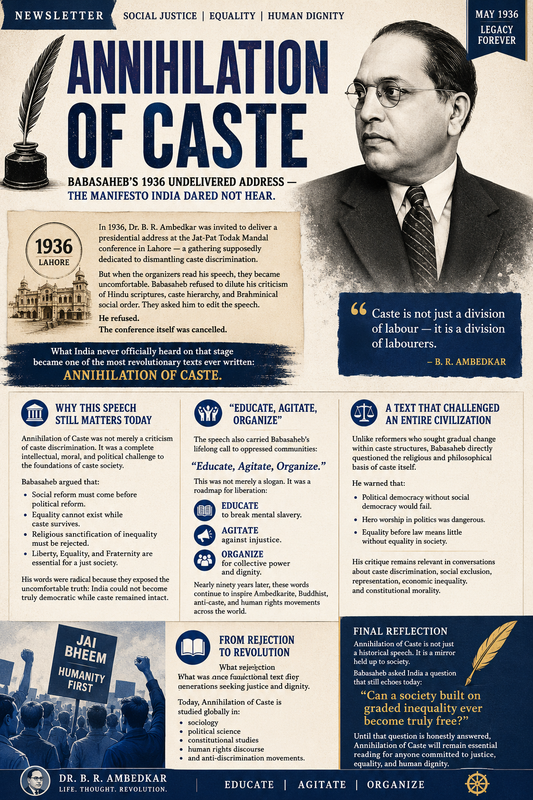
His words were radical because they exposed the uncomfortable truth: India could not become truly democratic while caste remained intact. “Educate, Agitate, Organize” The speech also carried Babasaheb’s lifelong call to oppressed communities: “Educate, Agitate, Organize.” This was not merely a slogan. It was a roadmap for liberation: Educate to break mental slavery. Agitate against injustice. Organize for collective power and dignity. Nearly ninety years later, these words continue to inspire Ambedkarite, Buddhist, anti-caste, and human rights movements across the world. A Text That Challenged an Entire Civilization Unlike reformers who sought gradual change within caste structures, Babasaheb directly questioned the religious and philosophical basis of caste itself. He warned that: Political democracy without social democracy would fail. Hero worship in politics was dangerous. Equality before law means little without equality in society. His critique remains relevant in conversations about: caste discrimination, social exclusion, representation, economic inequality, and constitutional morality. From Rejection to Revolution What was once rejected by elites became a foundational text for generations seeking justice and dignity. Today, Annihilation of Caste is studied globally in: sociology, political science, constitutional studies, human rights discourse, and anti-discrimination movements. The speech Babasaheb was denied the chance to deliver became louder than the platform that tried to silence him. Final Reflection Annihilation of Caste is not just a historical speech. It is a mirror held up to society. Babasaheb asked India a question that still echoes today: Can a society built on graded inequality ever become truly free? Until that question is honestly answered, Annihilation of Caste will remain essential reading for anyone committed to justice, equality, and human dignity.